Ten years at Valencia, then the long road: the documented career of Bilal Jabri
A goalkeeper born in 2004 in Extremadura, raised in one of Spain's most productive academies, now a free agent. This is what the documentation says — and what it does not establish.
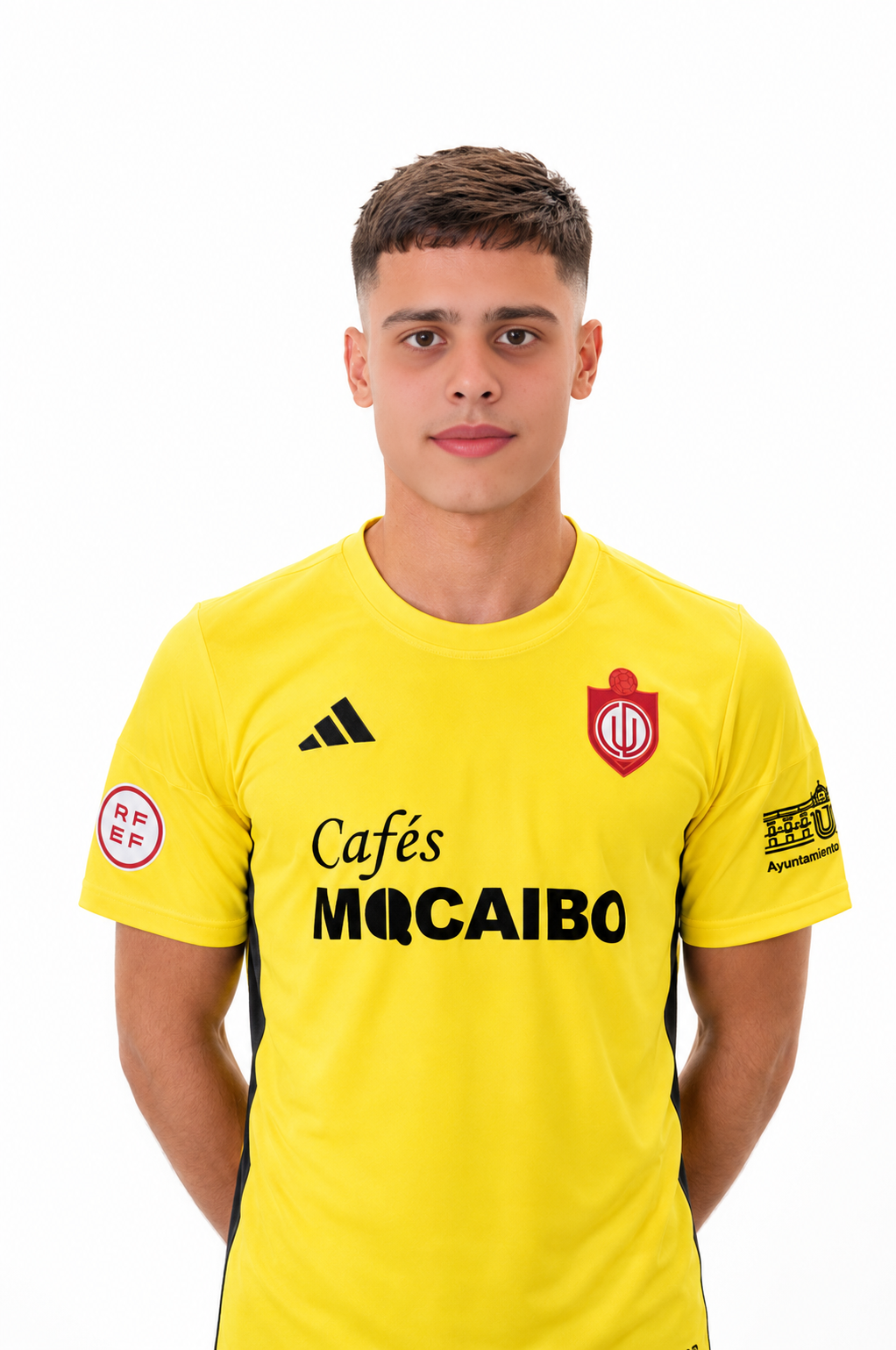
Navalmoral de la Mata is a town of roughly 17,000 people in the north-east of Cáceres province, closer to Madrid than to Seville and a long way from any elite academy. Bilal Jabri Jabri was born there on 6 June 2004, and by the account in the career dossier supplied to Meridian XI he was inside the Valencia CF system from 2010 — the year he turned six.
What the record contains
The document describes ten seasons in Valencia's academy, the club that produced a generation of Spanish internationals from a catchment area it guards carefully. It then lists a sequence of clubs that reads like a map of the Spanish pyramid below the professional divisions: Paterna C.F. and C.D. Roda in the Valencian Community, C.D. Diocesano and U.D. Montijo and C.P. Talayuela in Extremadura, C.D. Utrera in Andalusia, Atlético Pulpileño in Murcia, C.D. Castellón, and most recently C.P. Cacereño for 2024/25.
On honours, the record cites a LaLiga Promises title with Valencia in 2016 with an individual goalkeeping distinction, three Zamora awards at youth level between 2019 and 2022, and a Golsmedia award in 2021. On international football, it lists Moroccan youth call-ups across four age categories, including Under-17.
What the record does not establish
Every one of those items is a claim from a single document, and Meridian XI treats a single document as a starting point rather than a conclusion. We have not obtained confirmation from the RFEF, from the FRMF, or from any of the clubs named. Appearance counts, minutes and competition rounds are not in the file in a form that can be checked against a public register.
The dossier also presents itself with a "100% verified" seal and a blockchain-style hash. National federations do not issue player records that way. That does not make the contents false — most of the clubs and competitions listed are entirely ordinary steps for a Spanish goalkeeper of this generation — but it does mean the seal carries no evidential weight, and we will not repeat it as if it did.
Why the profile is still worth publishing
Because this is what a modern lower-division career actually looks like, and it is almost never written down. A goalkeeper leaves an elite academy at 16 or 17 and enters a market where contracts run a season at a time, travel is self-funded, and the difference between Tercera Federación and a regional league is one injury to somebody else. The nine-club list is not a curiosity; it is the standard shape of the pathway.
For a goalkeeper specifically, that pathway has changed since 2019. The revision to Law 16 allowed the ball to be played inside the penalty area at a goal kick, and Spanish academies moved fast to coach goalkeepers as first-phase passers. A 1.80m goalkeeper described as ambidextrous is a profile that grading systems undervalued a decade ago and now actively look for.
Jabri is currently a free agent. Meridian XI will update this file — and his database profile — if and when a club registration or federation record confirms, extends or contradicts what the dossier says.
Sources
- Documentary sourceCareer dossier supplied to Meridian XI (PDF, two versions), reviewed 10 August 2026
- Official sourceIFAB Laws of the Game, Law 16 (goal kick), 2019/20 revision
Related players
Related clubs
- Valencia C.F.
- C.P. Cacereño
- C.D. Castellón
Related competitions
- LaLiga Promises
Related articles
Expected goals measures the chance, not the finish
xG is a model output, not a fact about a match. What it does well, what it cannot see, and why post-shot models exist for goalkeepers.
One clause in Law 16 rewrote the goalkeeper's job description
Since the 2019/20 Laws of the Game, the ball is in play at a goal kick as soon as it is kicked — and receivers may stand inside the penalty area. Recruitment has not stopped adjusting since.
Below LaLiga: how the Spanish pyramid actually works
Two professional divisions, then three federation tiers organised into regional groups. It is the layer where most Spanish careers are actually lived.